My cat Herbie sleeps much more than his adopted brother Guinness. A lot of the time Guinness has no one to play with but me and I spend a great deal of time in front of my computer – which is no fun at all. Some of his favorite toys are little balls of fluff stuff that some knowing manufacturer covers with shiny metallic rays. We play fetch with these. Guinness will bring one into the study if I’m working, or into the kitchen if I’m cooking, and drop it by my feet. If I don’t get the idea, he’ll meow, annoyed. So I throw it and he runs after it, sliding on the wood floors. He’ll bat it around for a while then bring it back for me to throw again. These and other amusements – such as helping me make the bed – usually suffice but occasionally Guinness gets bored.
A bored Guinness is a dangerous Guinness.
With the infallible instincts of a two-year-old human, he knows what gets my attention. If I’m in my study, he will begin by climbing over papers and folders to the shelf where I keep small collection of significant rocks. With infinite care, he will select one particular stone and send it to the floor. If I still ignore him, he’ll find another. If, even then, I keep working, he goes to the books. Knocking a volume off the shelf almost always gets me off my chair.
And evidently Guinness finds the thud of a fallen hardbound book especially satisfying. When I hear it while I’m eating at the dining room table, I know one of the downstairs books has hit the floor. Unfortunately, several of the downstairs volumes, carefully placed in the built-in bookcase, are family treasures. They include books that my great grandmother gave to my great grandfather when they were courting.
He knocked down two of them last week. That was the last straw. I spent an entire morning moving things in the pantry so things in the kitchen cupboards could go in the pantry – then moving things in the china cabinet into the kitchen cupboard. Eventually, the two bottom shelves of the glassed-in china cabinet were clear. They became the new home for the treasured volumes. Finally, un-clunk-able.
It’s a damn good thing he’s cute.
Wednesday, June 30, 2010

Sunday, June 27, 2010
If the shoe fits . . .
Recently the New York Times published a little story about a 5,500-year-old shoe found in an Armenian cave. Made of high quality leather, with leather laces crisscrossing through numerous eyelets, it resembles a modern soft-soled walking shoe. Scientists believe the shoe was for a woman’s right foot, approximately size 7. It had been worn. The archaeologists saw big toe imprints and some of the eyelets had been torn and repaired.
The huge Armenian cave where the shoe was found has yielded an abundance of artifacts from the “Copper Age” when humans are believed to have invented the wheel and domesticated horses, among other advances. The cave’s treasures include evidence of winemaking and caches of intentionally dried fruits (apricots, grapes and prunes). Archeologists believe the cave was used by high status people to store their community’s harvest and ritual objects.
Other leather shoes, which may be equally old, have been found in the Middle East but not yet dated. Previously, the oldest known leather shoes belonged to a mummified man found in the Alps near the Italian-Austrian border. His shoes had bearskin soles, deerskin panels, tree-bark netting and grass socks. They were a little younger than the Armenian shoe, only about 5,000 years old.
Sandals have an even longer history; the oldest known specimens, dated to more than 7,000 years ago were found in central Missouri. And another recent New York Times item noted that Mesoamericans, such as the Aztec and Maya, made sandals out of rubber beginning about 1,600 B.C.E. (about 3,600 years ago).
I believe my ancestor, who lived about 12,000 years ago in northern Spain (see posts for June 11 and June 22) had some kind of foot protection. Indeed, European Stone Age skeletons have been found to have unusually small toes – suggesting that footwear of some kind was used by 40,000 years ago.
These little tidbits of time -- souvenirs of pre-history -- help me begin to comprehend the vast scope of the human saga. Instead of my prior stereotypes of hulking, grunting primitives, far less intelligent than their modern descendents, I begin to envision a long, long line of ancestor Cinderellas, sipping wine and eating dried apricots. Not a bad occupation in any age.
Thursday, June 24, 2010

Tuesday, June 22, 2010
Summer Solstice -- past and present
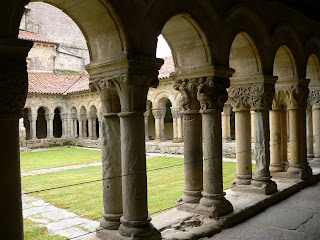
Monday, June 21, 2010 was the Summer Solstice in the northern hemisphere. In my genealogical memoir, Family Time, my ancient ancestor, Mirari explains the ceremonies that her people conducted at various times of the year. She convinces my two great grandmothers, three great aunts and two grandmothers and me to travel to northern Spain. Santillana Del Mar is the town closest to Altamira cave (see June 11 post). There is an old church at one end of the town and, attached, an even older cloister. Mirari remembers it, pre-cloister, when it was the site of Summer Solstice celebrations 12,000 years ago. The nine of us visit the cloister at the end of long day . . .
And none of this mattered to Mirari. Easing herself into the center of the lawn, the intersection of the stone paths, she raised her hands to the open sky in a manner that compelled the others to both attention and silence.
With unmistakable gestures, she directed Ma and Emma to stand on the north side, each under separate arcs of stone. Beryl and Hazel found their respective places on the west side. Zoe and Edna on the south. Mim and Nana on the east.
When all were positioned, standing (as Mim knew they should not) on the low stone wall supporting the columns, Mirari began to hum.
Instinctively, the others followed suit; with sounds first tentative then clear. Except for Nana, who had ruined her voice by smoking. Instead, she whistled softly. The combined sounds curled around the 900 year old structure, mingling with the prayers of medieval nuns and the thud of dancing feet from Mirari’s people. And the faint echoes of the interim faithful.
Then Mirari began to clap, very softly, turning in place to face each of the other women. And each of the other women responded by clapping softly until the cloister sounded vaguely like the waves on the seashore only a few miles away.
And they rode that sound in a way that connected the nine of them as they had not been connected before. And simultaneously they understood the power of the El Castillo ceremonies.
But it was inevitable. The church bells began tolling 7 o’clock. The grumpy guardian opened the door to shoo them out through the church and back into the village.
And they went. Muttering in unison: “I don’t want to leave.”

Once inside, the profound stillness of the cloister brought all nine women to a standstill. It was such a simple plan: a sheltered walkway surrounding a quadrangle of paired columns that in turn surrounded a lawn bisected by stone paths into four smaller quadrangles. Only after stopping to truly look would one notice that the pattern was not symmetrical. There were some groups of four columns. One gate. One arched double window with a roof higher than the rest of the wood-ceilinged perimeter. Many of the columns’ capitals were distinct, with arcane or obvious designs. Some patterns appeared only once. Others were repeated.
And none of this mattered to Mirari. Easing herself into the center of the lawn, the intersection of the stone paths, she raised her hands to the open sky in a manner that compelled the others to both attention and silence.
With unmistakable gestures, she directed Ma and Emma to stand on the north side, each under separate arcs of stone. Beryl and Hazel found their respective places on the west side. Zoe and Edna on the south. Mim and Nana on the east.
When all were positioned, standing (as Mim knew they should not) on the low stone wall supporting the columns, Mirari began to hum.
Instinctively, the others followed suit; with sounds first tentative then clear. Except for Nana, who had ruined her voice by smoking. Instead, she whistled softly. The combined sounds curled around the 900 year old structure, mingling with the prayers of medieval nuns and the thud of dancing feet from Mirari’s people. And the faint echoes of the interim faithful.
Then Mirari began to clap, very softly, turning in place to face each of the other women. And each of the other women responded by clapping softly until the cloister sounded vaguely like the waves on the seashore only a few miles away.
And they rode that sound in a way that connected the nine of them as they had not been connected before. And simultaneously they understood the power of the El Castillo ceremonies.
But it was inevitable. The church bells began tolling 7 o’clock. The grumpy guardian opened the door to shoo them out through the church and back into the village.
And they went. Muttering in unison: “I don’t want to leave.”
Sunday, June 20, 2010
My Dad
Okay. It’s Fathers Day. My father has been dead for eight years now but he is still part of who I am. Here’s a (long) excerpt from Chapter 12 of my memoir, Tree Lines:
As a child, I both worshiped and feared my father. He was The Authority, relaying undisputed rules to both my brother and me: we should be seen and not heard, speak only when spoken to, say 'please' and 'thank you', 'yes sir' and 'yes ma'am,’ and write thank you notes for every gift received. We were expected to be obedient and respectful.
He was by all suburban criteria, a good father, interested and involved in the lives of my younger brother and me. But in retrospect he set impossibly high standards for us and, if we did not meet them, subjected us to some pretty scathing sarcasm and teasing.
I don’t think he understood that I believed everything he said. He was my father. What he said was true. If we had trouble with homework, or figuring out how to fix something or why something worked the way it did, we were made to feel unbelievably stupid. It was like a perpetual oral exam.
Yet Dad could be a tender Authority. When I had my tonsils out at age three, he listened to my anger about being put in a crib and he made it okay. He conspired with us to learn "Jest Before Christmas" by Eugene Fields as a holiday surprise for my mom. He brought me a bike named "Grapefruit" on my birthday. He put the worms on my hook. And, decades later, he spent hours refinishing the antique bassinet I had found for my first child.
He taught me a great deal--basic stuff, like riding a bike, fishing, and the multiplication tables. He spent time with me as I struggled with homework. It was rewarding when I got it and mortifying when I did not.
Someone else was always telling me what he felt about something . . . especially if it was difficult or negative. He never discussed big issues directly. At best, he referred to a problem with dry wit or sarcasm. He rarely revealed any emotion except anger 'in front of the children,' and found it hard to deal with the emotions of others. That was true to the end of his days.
His focuses were his job and my mom. He went on a lot of business trips. When home, he seemed perpetually busy with projects in the house or yard. I used to say he invented the Puritan work ethic.
When they came, his approvals were 'Miss America' moments, crowning a day--when I wrote an 'A' paper or won some kind of prize at school.
Family vacations--when he was released from his personal grindstone--were the times that he focused on us. To find the fishing he loved, he took us north into Ontario and, after a few attempts, found 'our' fishing camp on Georgian Bay. We'd go up there every other summer and I got pretty good at fishing.
As a special treat on my 18th birthday, he took me out to a previously identified 'fishing hole' on the edge of the larger bay and let me catch both my limit and his. That night, we consumed our bounty accompanied by his famous fried potatoes and onions, and champagne from chipped ceramic mugs. It was one of the best birthday parties I ever had.
After my marriage, contact was less frequent. Whenever I would see him--usually on major holidays--he was charming and witty and supportive. He paid nice attention to my sons as soon as they could talk, and was cordial but remote with my husband.
In August 1975, I asked my parents to visit immediately after I told my husband I had filed for divorce. I was terrified. I wanted them to provide support and (if needed) protection. I remember standing on my front porch with Dad, talking about what would happen next. I knew the house would have to be sold and that I would need to get a job. I told him that we couldn't live on the proceeds from the program I had developed, but that I was pretty sure I could get some kind of writing job. He just said that he was sure I would do fine. It felt like he meant it and therefore it must be true.
He divorced my mom and remarried. It was more than 15 years before he and his second wife visited me. My sons were approaching ages 26 and 23 and had not seen him since they were small. They were both on their own, struggling to survive but surviving. Even though I had a beautiful co-op apartment and was doing well in a highly responsible job involving international travel, I felt like a five-year-old who had broken something.
The mere fact of his presence triggered the sense that I was not good enough.
In spite of that, his visit seemed an honest overture. He started writing me letters and, once a year, I tried to visit his home -- a truck farm in the country outside Naples, Texas. Even retired, he was still dad. He raised chickens, vegetables and berries–even a few head of cattle for a while. He tried, with less success, to start a peach orchard. He worked hard, up at dawn. He still could not talk about personal things. I’d tell him about my work. He’d show me his tomatoes. He only asked about my mom once, when he was sure his wife couldn’t hear.
In so many ways, he was hard to get to. Their place was a two-hour drive from the Dallas airport. The railroad was closer. Once I took the train down, a shabby, crowded version of the grand trains of my childhood. Going home, I had stepped up to the passenger car when I heard his voice behind me: “We are proud of you.”
I was Miss America again.
Thursday, June 17, 2010
Fathers Day
Although the exact date has not been determined, most scientists agree that our particular species has been around about 200,000 years. And most of us would acknowledge that our species would not have survived for 200,000 years without both fathers and mothers.
So you have to wonder why it took us so long to set aside one measly day a year to honor mothers and another one measly day a year to honor fathers.
Greeting cards – in the beginning at least – had nothing to do with it. Nor indeed did merchants of any kind.
Mothers Day came first. Observances were initiated by Unitarian Julia Ward Howe in 1872 as anti-war events. They continued about 10 years before the idea lost momentum. Then early in the 1900s, various communities and states began having ‘Mothers Day’ events. It became a national holiday in 1914.
The first Father's Day was observed on June 19, 1910 in Spokane, Washington. It was launched by Mrs. John B. Dodd to honor her father, a widower, who raised his six children as a single parent. Eventually, towns and cities across America began to celebrate a "father's day." In 1924, President Calvin Coolidge supported the idea of a national Father's Day but it was not until 1966 that Lyndon B. Johnson signed a presidential proclamation declaring the 3rd Sunday of June as Father's Day.
Today both Fathers Day and Mothers Day are part of this country’s culture. And however long it has taken us to create them, both observances are probably a good idea.
No father (or mother) is perfect. But most fathers have, in their own ways, done their best to nurture their kids, teach them the rules, and help them acquire the skills they need to survive, and even flourish. And if your father wasn’t particularly good at it, there probably was another adult male who was instrumental in helping you (at whatever age) reach adulthood.
So hooray for the 3rd Sunday in June. Hooray for fathers (or adult male substitute fathers). Bless them, honor them and try to give them better neckties this year.
Monday, June 14, 2010
Such a Deal
When my cats, Herbie and Guinness, began their lives with me (see June 8 post) I thought that Herbie – the older and slightly larger animal – would be the ‘alpha’ cat. I was wrong. Guinness has a tendency to bully his adopted brother. It took, literally, years before Herbie dared participate in any game that Guinness and I might be playing. He would watch with one eye from another room (half hidden by whatever wall was providing cover). Even now, he sometimes seems to hesitate to eat until he is sure Guinness is through.
But Guinness has proven to be astoundingly neurotic. Forceful with Herbie, he nonetheless is terrified by any human other than me. Most of my guests think I have only one cat because Guinness hides the moment the doorbell rings. Often he will burrow beneath my bedspread; evidently unaware that the lump he creates gives him away.
It’s not that the two don’t get along. They do. They play, chasing each other around the house; they groom each other, and often cuddle together in sleep looking like a furry yin yang symbol. Their hobbies include squirrel and bird watching and it is fun to see their heads turn in unison as furred or feathered creatures scamper or fly outside my windows.
Herbie is my official host cat. He loves visitors and expects focused affection from all who cross my threshold. When my writers group meets at my house, he will go from lap to lap until sufficient homage is paid. And most visitors are delighted – he is soft and beautiful – until they discover that he drools. He drools when he is happy and when he is frightened and sometimes just because. The worst is when he shakes his head, sending saliva flying.
The moment company leaves, Guinness shows up and we are a trio again. Both of them seem to love me unconditionally. They greet me when I come home from anywhere. Sensitive to my every mood and condition, they cuddle when I need comfort and use their vast repertoire of antics when I need cheering. They wait until they are sure I am sleeping before making their nocturnal rounds.
They provide me with love to give and receive and with something to focus upon besides my own problems or whatever I am writing. All I have to do is provide affection, food, water, clean litter boxes and occasional pedicures.
Such a deal.
Subscribe to:
Posts (Atom)


 Posts

