Not too long ago I didn’t know what ‘binary’ meant.
Not too long ago I didn’t know I knew any lesbians (although I was pretty sure I knew some gays).
A long time ago I didn’t know (or know I knew) any African Americans … or Asians … or Native Americans … or Latinix … or Muslims … or Turks … or Germans … or Buddhists … or Catholics (well, maybe some Catholics … and Jews) … or motorcyclists … or hunters … or homeless people … or differently-abled people … or really old people… or any people other than white, middle class, privileged people.
What a myopic view of the world! What an infinitesimal fragment of reality.
Recently I went to a lesbian wedding. It was a beautiful celebration of two people who radiate joy in being together. I was honored to be there, to witness their acknowledgement of the miracle of their love.
It is a miracle, you know… whenever it happens between/among whomever it happens.
Right now it seems utterly foolish to inhibit, in any way, any smidgen of joy.
When we open our eyes, minds, hearts to any* of our fellow passengers on this planet as it swirls within our galaxy, our heart is nourished … sustained. And we become more fully alive. [And increase the possibility of our own joy.]
(*Even Republicans ***)
(***with one possible exception)
Showing posts with label Making Connections. Show all posts
Showing posts with label Making Connections. Show all posts
Wednesday, July 17, 2019

Sunday, June 27, 2010
If the shoe fits . . .
Recently the New York Times published a little story about a 5,500-year-old shoe found in an Armenian cave. Made of high quality leather, with leather laces crisscrossing through numerous eyelets, it resembles a modern soft-soled walking shoe. Scientists believe the shoe was for a woman’s right foot, approximately size 7. It had been worn. The archaeologists saw big toe imprints and some of the eyelets had been torn and repaired.
The huge Armenian cave where the shoe was found has yielded an abundance of artifacts from the “Copper Age” when humans are believed to have invented the wheel and domesticated horses, among other advances. The cave’s treasures include evidence of winemaking and caches of intentionally dried fruits (apricots, grapes and prunes). Archeologists believe the cave was used by high status people to store their community’s harvest and ritual objects.
Other leather shoes, which may be equally old, have been found in the Middle East but not yet dated. Previously, the oldest known leather shoes belonged to a mummified man found in the Alps near the Italian-Austrian border. His shoes had bearskin soles, deerskin panels, tree-bark netting and grass socks. They were a little younger than the Armenian shoe, only about 5,000 years old.
Sandals have an even longer history; the oldest known specimens, dated to more than 7,000 years ago were found in central Missouri. And another recent New York Times item noted that Mesoamericans, such as the Aztec and Maya, made sandals out of rubber beginning about 1,600 B.C.E. (about 3,600 years ago).
I believe my ancestor, who lived about 12,000 years ago in northern Spain (see posts for June 11 and June 22) had some kind of foot protection. Indeed, European Stone Age skeletons have been found to have unusually small toes – suggesting that footwear of some kind was used by 40,000 years ago.
These little tidbits of time -- souvenirs of pre-history -- help me begin to comprehend the vast scope of the human saga. Instead of my prior stereotypes of hulking, grunting primitives, far less intelligent than their modern descendents, I begin to envision a long, long line of ancestor Cinderellas, sipping wine and eating dried apricots. Not a bad occupation in any age.
The huge Armenian cave where the shoe was found has yielded an abundance of artifacts from the “Copper Age” when humans are believed to have invented the wheel and domesticated horses, among other advances. The cave’s treasures include evidence of winemaking and caches of intentionally dried fruits (apricots, grapes and prunes). Archeologists believe the cave was used by high status people to store their community’s harvest and ritual objects.
Other leather shoes, which may be equally old, have been found in the Middle East but not yet dated. Previously, the oldest known leather shoes belonged to a mummified man found in the Alps near the Italian-Austrian border. His shoes had bearskin soles, deerskin panels, tree-bark netting and grass socks. They were a little younger than the Armenian shoe, only about 5,000 years old.
Sandals have an even longer history; the oldest known specimens, dated to more than 7,000 years ago were found in central Missouri. And another recent New York Times item noted that Mesoamericans, such as the Aztec and Maya, made sandals out of rubber beginning about 1,600 B.C.E. (about 3,600 years ago).
I believe my ancestor, who lived about 12,000 years ago in northern Spain (see posts for June 11 and June 22) had some kind of foot protection. Indeed, European Stone Age skeletons have been found to have unusually small toes – suggesting that footwear of some kind was used by 40,000 years ago.
These little tidbits of time -- souvenirs of pre-history -- help me begin to comprehend the vast scope of the human saga. Instead of my prior stereotypes of hulking, grunting primitives, far less intelligent than their modern descendents, I begin to envision a long, long line of ancestor Cinderellas, sipping wine and eating dried apricots. Not a bad occupation in any age.
Tuesday, June 22, 2010
Summer Solstice -- past and present
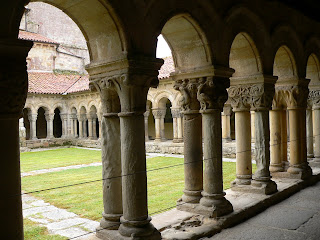
Monday, June 21, 2010 was the Summer Solstice in the northern hemisphere. In my genealogical memoir, Family Time, my ancient ancestor, Mirari explains the ceremonies that her people conducted at various times of the year. She convinces my two great grandmothers, three great aunts and two grandmothers and me to travel to northern Spain. Santillana Del Mar is the town closest to Altamira cave (see June 11 post). There is an old church at one end of the town and, attached, an even older cloister. Mirari remembers it, pre-cloister, when it was the site of Summer Solstice celebrations 12,000 years ago. The nine of us visit the cloister at the end of long day . . .
And none of this mattered to Mirari. Easing herself into the center of the lawn, the intersection of the stone paths, she raised her hands to the open sky in a manner that compelled the others to both attention and silence.
With unmistakable gestures, she directed Ma and Emma to stand on the north side, each under separate arcs of stone. Beryl and Hazel found their respective places on the west side. Zoe and Edna on the south. Mim and Nana on the east.
When all were positioned, standing (as Mim knew they should not) on the low stone wall supporting the columns, Mirari began to hum.
Instinctively, the others followed suit; with sounds first tentative then clear. Except for Nana, who had ruined her voice by smoking. Instead, she whistled softly. The combined sounds curled around the 900 year old structure, mingling with the prayers of medieval nuns and the thud of dancing feet from Mirari’s people. And the faint echoes of the interim faithful.
Then Mirari began to clap, very softly, turning in place to face each of the other women. And each of the other women responded by clapping softly until the cloister sounded vaguely like the waves on the seashore only a few miles away.
And they rode that sound in a way that connected the nine of them as they had not been connected before. And simultaneously they understood the power of the El Castillo ceremonies.
But it was inevitable. The church bells began tolling 7 o’clock. The grumpy guardian opened the door to shoo them out through the church and back into the village.
And they went. Muttering in unison: “I don’t want to leave.”

Once inside, the profound stillness of the cloister brought all nine women to a standstill. It was such a simple plan: a sheltered walkway surrounding a quadrangle of paired columns that in turn surrounded a lawn bisected by stone paths into four smaller quadrangles. Only after stopping to truly look would one notice that the pattern was not symmetrical. There were some groups of four columns. One gate. One arched double window with a roof higher than the rest of the wood-ceilinged perimeter. Many of the columns’ capitals were distinct, with arcane or obvious designs. Some patterns appeared only once. Others were repeated.
And none of this mattered to Mirari. Easing herself into the center of the lawn, the intersection of the stone paths, she raised her hands to the open sky in a manner that compelled the others to both attention and silence.
With unmistakable gestures, she directed Ma and Emma to stand on the north side, each under separate arcs of stone. Beryl and Hazel found their respective places on the west side. Zoe and Edna on the south. Mim and Nana on the east.
When all were positioned, standing (as Mim knew they should not) on the low stone wall supporting the columns, Mirari began to hum.
Instinctively, the others followed suit; with sounds first tentative then clear. Except for Nana, who had ruined her voice by smoking. Instead, she whistled softly. The combined sounds curled around the 900 year old structure, mingling with the prayers of medieval nuns and the thud of dancing feet from Mirari’s people. And the faint echoes of the interim faithful.
Then Mirari began to clap, very softly, turning in place to face each of the other women. And each of the other women responded by clapping softly until the cloister sounded vaguely like the waves on the seashore only a few miles away.
And they rode that sound in a way that connected the nine of them as they had not been connected before. And simultaneously they understood the power of the El Castillo ceremonies.
But it was inevitable. The church bells began tolling 7 o’clock. The grumpy guardian opened the door to shoo them out through the church and back into the village.
And they went. Muttering in unison: “I don’t want to leave.”
Saturday, May 15, 2010
Intentional Families
There are all kinds of intentional families.
Service clubs, like Rotary and Lions, were part of our response to the increased isolation that paradoxically occurs when city populations reach a certain mass.
Interestingly, women’s clubs -- started in the mid to late 1800s – were the forces behind many ‘civilizing’ changes, such as libraries and juvenile courts. They gave power to the non-yet-franchised and places where women would be listened to … with respect.
Alcoholics Anonymous, and other ‘twelve step’ programs, become family for participants. The kind of family that enables survival, even transformation.
Transformation – or at least personal acknowledgement – can be provided by congregations – of any faith.
And who can discount “Cheers” – ‘where everybody knows your name.’
Isn’t that what we are looking for? Personal acknowledgement, support, people who listen to us and laugh with us?
One way or another, through work or worship or efforts on behalf of a particular cause, we find ways to connect. And if we are not interested in ‘organized’ connections, then we create, as Kerrie commented, networks of friends.
I am wary of cyber-networks but they work for some. And it is nice to open my email to find a message from someone I worked with in Cape Town and another from my grand niece in Denver.
It’s even nicer to sit around a table and share personal news and fears and a corny but slightly bawdy joke that you would not tell just anyone.
Eventually, and sometimes it just takes growing up, we realize that no man – or woman – is an island. We are all part of the vast web of our species – related to each other in ways deeper than those mere accidents of race, religion, geography or culture that too often separate us. And that we too often use as excuses to avoid connections.
What Lincoln warned about a ‘house divided’ is still true – not just of our country, but of our planet. The survival of our species may require us to acknowledge that we are all in this together.
So, if you don’t have a family (or you don’t like the one you have) find one, create one.
Connect.
Service clubs, like Rotary and Lions, were part of our response to the increased isolation that paradoxically occurs when city populations reach a certain mass.
Interestingly, women’s clubs -- started in the mid to late 1800s – were the forces behind many ‘civilizing’ changes, such as libraries and juvenile courts. They gave power to the non-yet-franchised and places where women would be listened to … with respect.
Alcoholics Anonymous, and other ‘twelve step’ programs, become family for participants. The kind of family that enables survival, even transformation.
Transformation – or at least personal acknowledgement – can be provided by congregations – of any faith.
And who can discount “Cheers” – ‘where everybody knows your name.’
Isn’t that what we are looking for? Personal acknowledgement, support, people who listen to us and laugh with us?
One way or another, through work or worship or efforts on behalf of a particular cause, we find ways to connect. And if we are not interested in ‘organized’ connections, then we create, as Kerrie commented, networks of friends.
I am wary of cyber-networks but they work for some. And it is nice to open my email to find a message from someone I worked with in Cape Town and another from my grand niece in Denver.
It’s even nicer to sit around a table and share personal news and fears and a corny but slightly bawdy joke that you would not tell just anyone.
Eventually, and sometimes it just takes growing up, we realize that no man – or woman – is an island. We are all part of the vast web of our species – related to each other in ways deeper than those mere accidents of race, religion, geography or culture that too often separate us. And that we too often use as excuses to avoid connections.
What Lincoln warned about a ‘house divided’ is still true – not just of our country, but of our planet. The survival of our species may require us to acknowledge that we are all in this together.
So, if you don’t have a family (or you don’t like the one you have) find one, create one.
Connect.
Subscribe to:
Posts (Atom)


 Posts
Posts

